Choosing the right mobile app development company as a partner in India can make or break your digital initiative.
With India’s IT services market already valued at $42.7 billion in 2025, the choices are abundant—but true strategic partners are rare. The right software development company does far more than ship code. They reduce execution risk, improve speed to market, bring product thinking, and increasingly, help enterprises embed AI into their platforms from day one.
For directors, owners and business leaders, vendor selection is no longer a sourcing decision alone—it’s a growth decision.
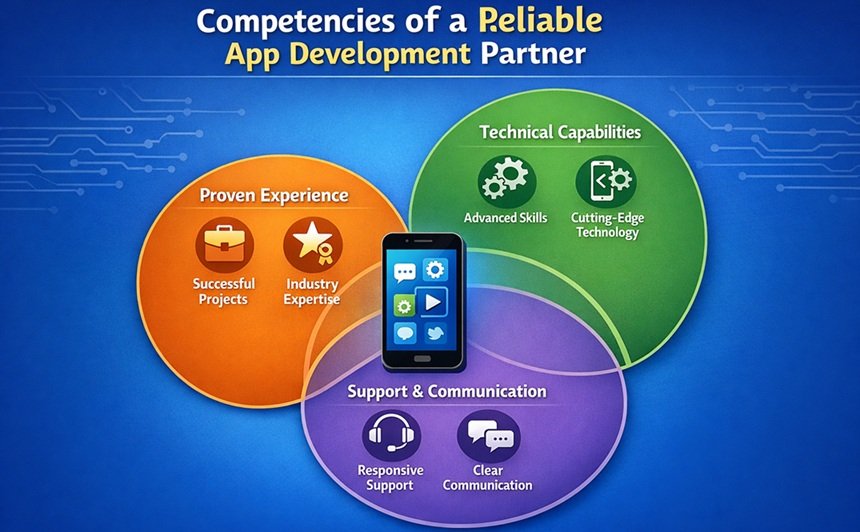
Here are 12 essential questions every client should ask before choosing their mobile app development partner.
1) What relevant experience do you have in our industry?
Industry context often determines whether a product succeeds in the market or struggles after launch. An app development company which has worked with clients of a specific sector better understands the problems and opportunities in those use-cases. At the same time , we should be sufficiently broad – for example saying that we want a vendor who has fin-tech experience rather than one who has specifically worked with lets say ‘car insurance’ may be a better approach – because there are other factors in play that may stand a vendor apart from others.
Why is this important?
A technically strong team can still fail if they don’t understand your domain workflows, compliance needs, customer journeys, or operational nuances. Building for healthcare, BFSI, retail, or SaaS requires different assumptions. Domain familiarity reduces discovery cycles and prevents expensive rework.
What gives a vendor an edge?
A strong partner brings domain accelerators, reusable frameworks, compliance knowledge, and battle-tested UX patterns from similar industries. They ask sharper questions because they’ve seen the problems before.
How is AI impacting this?
AI is making domain knowledge even more valuable. Vendors now use industry-trained copilots, workflow intelligence, and domain-specific LLM use cases to improve personalization, automation, fraud detection, support workflows, and decision intelligence.
2) Can you share case studies or live products?
While it is easier to make a slide deck look impressive – confidence comes from shipped outcomes. So, if there are live cases studies that are available on the app development partner’s website or can be provided by them, that’s surely something in their favor.
Why is this important?
Case studies reveal whether the vendor can move from strategy to execution. Live products show real-world usability, performance, adoption, and scalability under actual customer conditions.
What gives a vendor an edge?
The best vendors share business outcomes, measurable KPIs, product screenshots, architecture choices, GTM impact, and lessons learned – not just logos and vanity metrics.
How is AI impacting this?
Modern case studies increasingly showcase AI-powered recommendation engines, intelligent search, predictive analytics, support bots, document automation, and workflow copilots. The presence of real AI use cases signals innovation maturity.
3) What is your core tech stack?
This is one of the first questions to ask an app development company because technology choices influence scalability, hiring, cost, and future flexibility not just for them but for you as a client.
Why is this important?
A mismatch in stack expertise can slow delivery and increase technical debt. This becomes especially important when you need a .NET development company in India, cloud-native architecture, or mobile-first product development. If you’ve existing apps or resources on tech stack that has served your company well , then a vendor with expertise in that stack is surely welcome. For example :- Creative Spark Solutions has expertise in Flutter (for cross platform), React Native, .net MAUI as well as native Android development. On the backend side, we’re a well experienced dot net development company.
What gives a vendor an edge?
Vendors gain an advantage when they have depth—not just breadth. Strong specialization in .NET, React, Node, Azure, AWS, Flutter, or enterprise integrations helps accelerate development and improve maintainability.
How is AI impacting this?
AI-assisted development is transforming tech stack efficiency. Teams using GitHub Copilot, code-generation tools, automated test creation, and AI refactoring assistants can dramatically reduce development time while improving consistency.
4) How do you handle scalability?
This is an important question as a client because every company wants their app to scale, but when it does scale, their app’s architecture and compute should be able to handle that traffic.
Why is this important?
Products that work for 1,000 users may fail at 100,000. Clients need confidence that the architecture can handle growth in users, transactions, geographies, and integrations.
What gives a vendor an edge?
An experienced mobile app development company in India would think in terms of modular architecture, cloud elasticity, microservices, event-driven systems, caching, and performance engineering from the beginning.
How is AI impacting this?
AI is changing scalability planning through predictive infrastructure monitoring, anomaly detection, autoscaling intelligence, and AI-led observability tools that forecast traffic spikes before failures happen.
5) What is your development methodology?
As a client this question may be important to your in-house team as they may be following the Scrum, Kanban, TDD framework or some other development methodology which naturally they’d like the development partner to follow as well for a project.
Why is this important?
Without the right delivery framework, priorities drift, scope expands, and leadership loses visibility. Agile, Scrum, or hybrid models should align with your internal governance style.
What gives a vendor an edge?
The strongest partners tailor methodology to business maturity. They combine Agile ceremonies, sprint visibility, roadmap alignment, release governance, and product analytics feedback loops.
How is AI impacting this?
AI is now assisting sprint planning through story estimation, dependency detection, sprint risk alerts, backlog grooming suggestions, and velocity forecasting.
6) How do you ensure code quality?
This question is something that should be asked in the first or second meeting because a good app development partner will be able to easily tell industry standard processes and tools that they use for maintaining Quality. Higher Quality means lower bugs, quicker launches and satisfied end users.
Why is this important?
Poor code quality leads to bugs, outages, rising maintenance costs, and slower releases. Directors feel this later as customer dissatisfaction and engineering inefficiency.
What gives a vendor an edge?
Look for maturity in test automation, CI/CD pipelines, peer reviews, security scans, regression frameworks, performance testing, and shift-left QA practices.
How is AI impacting this?
AI is dramatically improving quality through automated test generation, intelligent code review, bug prediction, vulnerability scanning, and root-cause analysis recommendations.
7) Who owns the IP and source code?
This is a business continuity question, not just a legal one. This is especially important if your app has any differentiating or patentable aspect. But even aside, source code ownership should explicitly be documented in the commercial agreements.
Why is this important?
If ownership terms are unclear, your organization may face dependency risk, licensing issues, or expensive vendor lock-in during future transitions.
What gives a vendor an edge?
A trustworthy partner is transparent about IP transfer clauses, repository access, documentation ownership, deployment credentials, and handover processes from day one.
How is AI impacting this?
AI introduces new considerations around training data ownership, model IP, prompt libraries, generated code licensing, and proprietary algorithm rights. Directors must now clarify ownership beyond traditional source code.
8) What is your communication structure?
Execution issues are often communication failures in disguise. In this question a client is basically asking who do they reach out to – for project updates, for defects, for pre-launch and post-launch support etc , and whether their are backups in place.
Why is this important?
Even strong engineering teams underperform when communication is inconsistent. Directors need clear reporting, stakeholder mapping, escalation paths, and predictable governance.
What gives a vendor an edge?
A strong vendor creates single-threaded ownership, clear SPOCs, leadership reviews, risk dashboards, weekly governance calls, and transparent escalation matrices.
How is AI impacting this?
AI is improving communication through automated status summaries, meeting transcription, decision tracking, sentiment analysis, and proactive risk notifications.
9) How do you manage risks and delays?
The right answer to this question is not “we never miss deadlines.” lol. No one can claim to have fool-proof delivery execution but as long as they have processes, playbooks, dashboards and mechanisms to manage risks , you as a client , can probably sleep easier.
Why is this important?
Every complex product initiative faces unknowns. What matters is how early issues are surfaced and how responsibly they are mitigated.
What gives a vendor an edge?
Top vendors use risk registers, dependency mapping, buffer-based sprint planning, early warning dashboards, and leadership escalation frameworks.
How is AI impacting this?
AI now helps identify schedule risks via historical sprint pattern analysis, dependency prediction, blocker detection, and delay probability scoring.
10) What post-launch support do you offer?
This question is very important and something that is missed a lot. The launch of your app is the beginning of value realization, not the end. Therefore, if a development partner is able to offer post launch support then this is good point in their favor.
Why is this important?
Products evolve continuously after go-live through user feedback, bug fixes, compliance updates, and feature enhancements.
What gives a vendor an edge?
The best partners offer structured SLAs, L2/L3 support, performance optimization, release management, product analytics monitoring, and roadmap enhancement support.
How is AI impacting this?
AI is redefining support with self-healing systems, predictive incident detection, intelligent ticket triaging, and support copilots for faster resolution.
11) Can you scale the team quickly?
This is not a deal-breaker but something you can ask if the app development partner is small. Working with a small partner actually has benefits provided they are able to scale the team if needed – for large projects which may expand in size and scope.
Why is this important?
Roadmaps evolve due to customer feedback, competitive pressure, funding events, or internal pivots. Your partner must scale without compromising quality.
What gives a vendor an edge?
Vendors with bench strength, cross-skilled pods, rapid onboarding frameworks, reusable components, and strong hiring engines can ramp faster.
How is AI impacting this?
AI accelerates onboarding through codebase summarization, documentation copilots, automated knowledge transfer, and intelligent repository navigation.
12) What differentiates you from other vendors?
This question reveals whether the vendor understands their real value. Their is no right or wrong answer but a good app development company will surely be able to count some aspects which makes working with them an attractive option as compared to others. This can be a tie-breaker question to decide on which mobile app development company to choose.
Why is this important?
A weak answer often signals a commoditized service provider. A strong answer shows conviction, clarity, and long-term partnership potential.
What gives a vendor an edge?
The real edge lies in product mindset, domain expertise, engineering excellence, GTM understanding, AI readiness, and proactive problem-solving culture.
How is AI impacting this?
In 2026 and beyond, differentiation increasingly comes from a vendor’s ability to combine software engineering + AI transformation + data strategy + product innovation into one execution model.
Final Thoughts
The best software development partners don’t just answer these questions well, they ask better questions back. These questions can be added as part of your RFP to prospective development partners and help you on the burning question: how to choose a mobile a mobile app development company which fits your requirements !
For directors, product and technical leaders of SMEs, the goal is not finding the lowest-cost vendor. It is finding a strategic technology partner that can scale with your roadmap, reduce execution risk, and help your business stay AI-ready for the next decade.
In a crowded market, the real differentiator is not coding capability alone. It’s business alignment, domain intelligence, and future-focused execution. Work with Creative Spark Solutions – a mobile app development serving Gurgaon, Delhi /NCR today, to help understand your mobile app development needs and suggest the best possible solution.
So , how did you like our article on “How to select a mobile app development company?” Let us know in comments where you are in your app development journey or reach out to us on our inquiry form if you need any advice or help.